contact us

You can use the form on the right to contact us. Once we respond, you will be able to include any inspirational images you may have. You may also just email directly at:

info@handmaderevolution.org


Toronto
Canada

(416) 523-1625

Handmade, modern and historical metal and leatherwork. 

pendant logo copy.jpg

Blog

All the latest news and upcoming events. 

Leather care

Aurora Simmons

20200801_153853~2.jpg

Due to the pandemic, you may be stuck at home, bored and lacking in things to do right now.

If so, it’s a great time to take care of your leather. If you have modern or historical leathers, they all need love to last the longest and look their best. Leather lasts longest when it is regularly oiled with the right sort of oil or conditioner and kept clean of dirt and especially the salt that can build up on shoes in the winter.

For shoes, I often use Kiwi mink oil. You can usually get it at your local drug store or order it online. It’s a bit stinky, but it’s great for conditioning leather. I recommend it for shoes, and other things that won’t be touching your clothes a lot, because it tends to leave a residue. If you’re not squeamish you can just put it on your fingers and rub it into the leather, but you can also rub it on a cloth first and rub it in that way.

I put it on my soft leather shoes periodically throughout the winter. Make sure you clean any salt residue off first with a little vinegar and water on a paper towel. Let it dry and then rub the mink oil in. Then you can leave it to set for a few hours and they are ready to wear. It will darken the colour of your leather a fair bit so if that is a concern, use one of the other suggestions I will mention below. Mink oil helps leather be water-resistant as well as keeping it supple and prolonging its use. This method is also good for leather bags you might use for camping, especially if they are hand made in vegetable-tanned leather, but I wouldn’t use it on a modern purse. For that I would use an appropriately coloured show cream, as I will discuss below, or a neutral conditioner.

For shoes that are leather and have a modern finish, such as dress shoes, or docs, I recommend any drug store leather polish. You can buy a leather cleaner from the store or you can just use the vinegar method I mentioned above. Always clean the leather before applying the polish.

Once the shoes are dry, use a cloth to apply the polish to the shoes. After you have covered the shoe, let sit for 10 minutes and then rub any excess off with a soft, clean cloth. You can do this a couple of times for extra shine. The polish will also condition the leather and help it last longer. You can get black, brown or neutral polish with relative ease. You can also order coloured shoe cream online if you would like to colour match a leather that is green or red etc. Moneysworth and Best is a good brand. Lincoln Stain wax is also not bad, and more affordable, but it sometimes leaves a waxy residue in low areas and is only available to order within the USA. You can also get a neutral coloured leather conditioner by Fiebings. Rub it in, and then rub off any excess.

Do not use mineral oil on leather, as it will dry it out.

For most belts you buy in a store, drugstore leather polish will work well. Make sure the belt is real leather before using polish of any sort on it. If you use black leather polish on a belt, make sure to rub it thoroughly with a clean soft clean cloth afterwards, until you are sure that the residue has been removed, otherwise it might stain your clothes.

For a belt that I have made or a belt that is hand-dyed, you can still use drug store polish if the colour matches, or any of the conditioners I mentioned above except mink oil. Mink oil will make your belt too greasy.

You can also recondition the back of the belt by laying it flat on a surface and rubbing beeswax into the leather in long even strokes. You can go over it as many times as you want. This will help keep the back from getting furry from wear. You can also support the belt in your hand and rub beeswax along the edges in order to smooth them down. Try not to fold the belt horizontally while you do this, support it with your non-dominant hand. You will get a groove in your beeswax block as you go, and you will probably get some beeswax on the face of the belt which is fine. Once you are finished with the edges, just take a clean cotton cloth and gently rub the face of the belt, and that will smooth the beeswax out and help condition the surface as well.

None of these suggestions are recommended for suede leather. I don’t have much experience with it, so I don’t want to give advice in that area.

Hope this is helpful and feel free to email me at info@handmaderevolution.org if you have any questions. A wide selection of my leather belts including medieval and modern are listed on my etsy page.

2020 update

Aurora Simmons

One of our new Vintage offerings.

One of our new Vintage offerings.

It’s been a wild ride since lockdowns began in March. I moved to making fabric face masks for a while, while we were locked down and I couldn’t access my jewellery bench. I am still making fabric masks and feel free to contact me if you are looking for some.

Since restrictions lifted in Toronto, I have been able to get back to jewellery making with a few blips here and there when covid related precautions needed to be taken at my studio.

I have certainly not caught up on the nearly 2 months of work I missed but I am slowly making progress.

For the time being my suppliers are open and with caution and care I am able to work as I normally would. It’s been a very challenging year for sure. My partner and I had covid in March, and he has experienced many of the long-hauler symptoms over the last 7 months, so it has been especially difficult. I am happy to say that he does seem to be solidly on the mend now.

There have been a few fun new developments though. I was able to partner with a friend in order to bring you a remarkable selection of Vintage rings. I encourage you to have a look through them. They are both unique and spectacular.

I am working on a few new designs to add to my collections for the upcoming gift giving season. Jewellery can add a much needed mood boost in these stressful times. And earrings and necklaces can make you feel like you’ve made an effort, even when you are on a zoom call.

The best way to stay up to date on all my new designs as they come out is to follow me on Instgram or Facebook where I post regularly.

Another fun new development has been a budding partnership with Sorbet Sapphire, to use some of their colourful gemstones in my upcoming designs, so look for those pieces, coming soon.

I hope you and your families are weathering the storm as best you may be. I hope to be bringing you more information rich blogs in the near future.

Aurora


All about (medieval) belts

Aurora Simmons

It’s been a long time since I blogged, over a year in fact, but I’m going to try to clean up my act and get back on the horse, starting with a little post about medieval belts, since as spring comes, I am starting to think about my upcoming projects for the reenacting season.

I love reenacting the 14th century so much, in part because the possibilities for belts and bling are pretty much infinite.

Knights were often known to wear two belts at a time, a fancy one, and one to hold up their sword. Medieval folks also used things like horn baldrics, sword scabbard suspension rigs, armour closure straps, garters and more, so the need for belt like objects when reenacting the medieval period is near infinite. No one has asked me to make really fancy medieval horse furniture yet, but hope springs eternal.

A lot of my belt research has come from visual art sources from the period like paintings, manuscripts and effigies, but I’ve also been lucky enough to examine a few originals or photographs of originals from museum collections, and I even have a small collection of original belt plaques and buckles which have given me great insight. I’ve also found the book Dress Accesories, 1150 c to 1450 c - Medieval finds from excavations in London to be an invaluable resource.

Knights wearing belts in battle

Knights wearing belts in battle

Example of an effigy

Example of an effigy

More knights, with many fancy straps.

More knights, with many fancy straps.

Most outfits for men in the 14th century included a belt, to hold purses or weapons, and to cinch the loose over-garments they often wore. Women wore belts more situationally depending on whether they were dressed in formal wear, or working clothes. The belt was often used to raise long skirts off the ground when a woman needed less restricted movement and were used to support purses, the pockets of the 14th century. They were also used to cinch loose over-garments, just like for men.

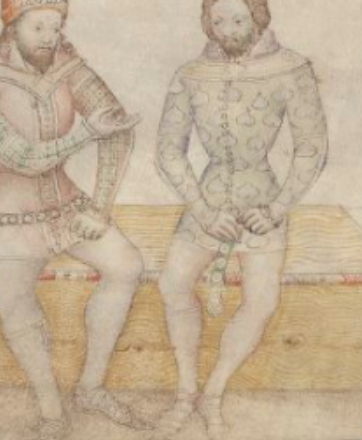
Some fancy lads wearing belts in the Giron le Courtois manuscript.

Some fancy lads wearing belts in the Giron le Courtois manuscript.

A nice lady wearing a belt from Tacuinum Sanitatis

A nice lady wearing a belt from Tacuinum Sanitatis

Sometimes belts were tablet woven to create bright patterns in fabric instead of leather. I had the pleasure of working with a friend to create one of these in silk a few years ago. She did the weaving and I assembled the metal fittings which I then sewed on.

Tablet woven silk belt with extra bling

Tablet woven silk belt with extra bling

The full ensemble.

The full ensemble.

Belts were often decorated. Sometimes with a texture embossed into the leather, sometimes with closely spaced metal fittings. They were usually brightly coloured, either in dyed leather or woven fabric. I have a bunch of reproduction embossing stamps I’ve made in brass, and hammering a stamp into wet leather is deeply satisfying.

Belts were sometimes used to denote status, as with the heavily decorated knights belts. Sometimes they had enamelled heraldic plaques riveted or sewn to a backing or heavy, all metal plaques that are often seen on Germanic effigies from the period. Plaques could be made in a copper alloy, and either left alone, or plated silver or gold. But they were also made in more precious metals such as silver, or even gold for high status people. It was a great display of wealth and there have even been accounts of knights removing a belt plaque to use it as currency.

Another fancy lad from Giron le Courtois

Another fancy lad from Giron le Courtois

Original heraldic enamelled belt plaques

Original heraldic enamelled belt plaques

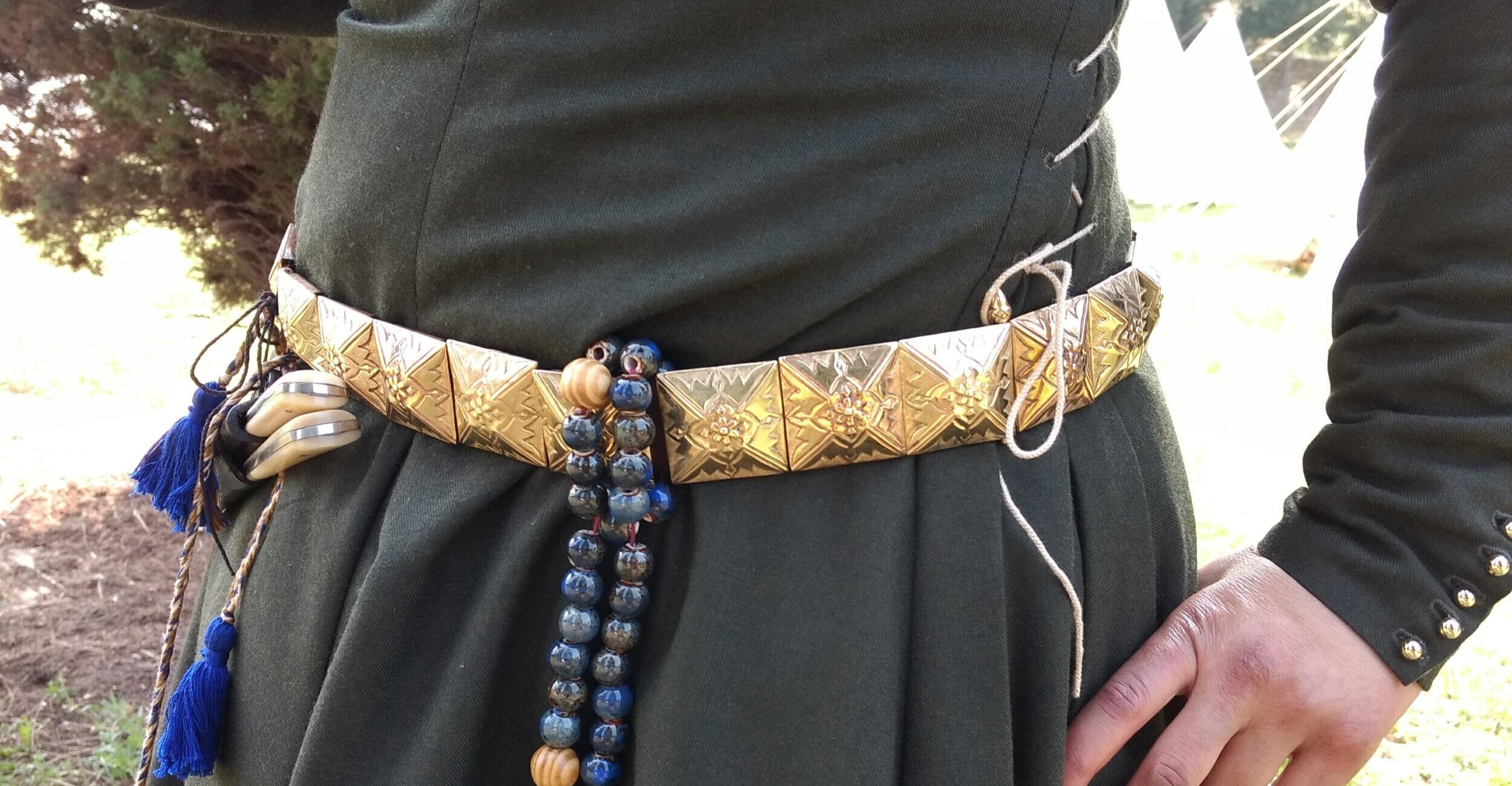
A reproduction belt I made with enamelled plaques on silk velvet.

A reproduction belt I made with enamelled plaques on silk velvet.

A very serious plaque belt I reproduced in 2018

A very serious plaque belt I reproduced in 2018

I’m proud to say that I’ve recreated all kinds of belts from the medieval period, and I enjoy it so much I have started making modern belts as well. Sometimes they draw on elements of historical belts for a modern twist on an historical theme. I own around 3 medieval belts of my own and I’m working on a 4th. Really, you can never have too many belts.

An embossed belt I made myself a few years ago. It’s been in some rainstorms since then, and it’s a little worse for wear now.

An embossed belt I made myself a few years ago. It’s been in some rainstorms since then, and it’s a little worse for wear now.


Next time, I’ll talk about how to care for belts, and leather in general. Hopefully it will be in the next 2 weeks rather then over a year from now.

If you’d like to see a selection of my modern and historical belts, head over to my etsy store

If you want to stay up to date with what I’m doing on a day to day basis, you can check out my Instagram or Facebook.

If you want to learn more about my historical reenacting organization, click here.

If you want to be notified about events, new blogs posts and sales, you can join our mailing list.

Feel free to leave a comment if you have any thoughts or questions.